California Republicans urge Supreme Court to strike congressional map as racially discriminatory

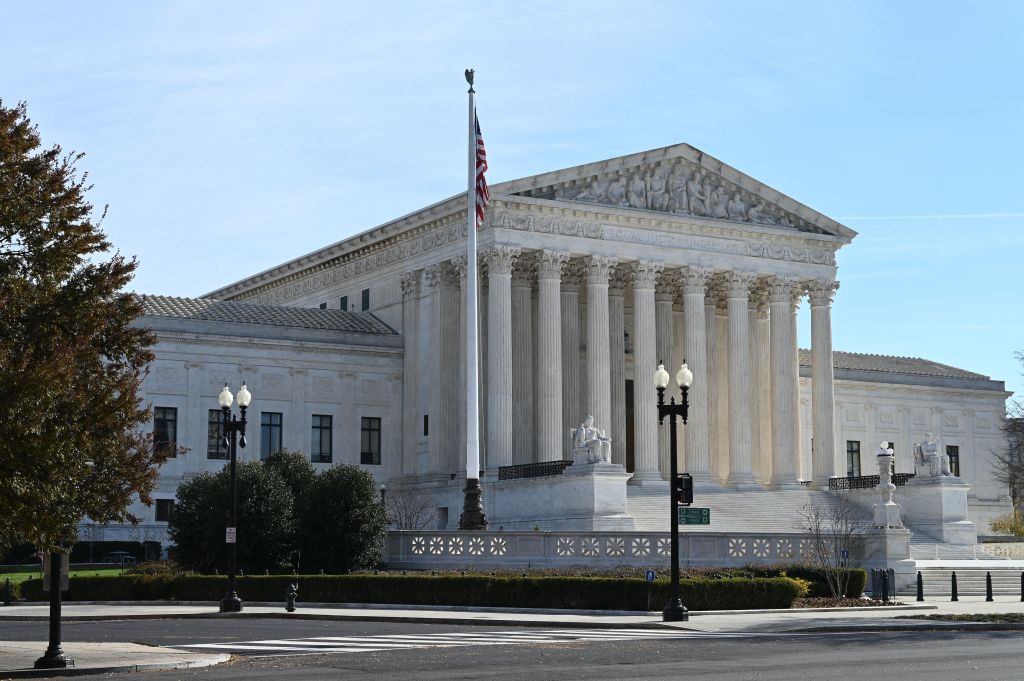
In December, the Supreme Court allowed Texas to use a new congressional map enacted to give Republicans five additional seats in the U.S. House of Representatives, blocking a lower court’s ruling that the map unconstitutionally sorted voters based on race. On Tuesday night, Republicans came to the Supreme Court, asking the justices to prohibit California from using a new map – adopted in response to Texas’ map – that added five Democratic seats there. In a filing obtained by The New York Times, lawyers for California Republicans challenging the new map decried what they characterized as the “pernicious and unconstitutional use of race” “[u]nder the guise of partisan line-drawing” in creating the 2025 map.
The challengers asked the justices to go ahead and order additional briefing and oral arguments in the dispute. They also asked the court to rule on their request to pause the lower court’s ruling by Feb. 9, when the window opens in California for candidates seeking to run for Congress to file paperwork declaring their candidacies.
States normally redraw their congressional maps just once every 10 years in response to the decennial census. But with a thin margin in the House, and under pressure from the Department of Justice, Texas in August adopted a new map that it hoped would result in Republican wins in 30 of 38 congressional seats – an increase of five seats over the previous map.
A three-judge federal district court – which Congress tasks with hearing challenges to the constitutionality of the apportionment of congressional districts – on Nov. 18 barred Texas from using the map in the 2026 elections. The majority concluded that although “politics played a role in drawing” the new map, there was “[s]ubstantial evidence … that Texas racially gerrymandered the 2025 map.”
Texas went to the Supreme Court three days later, and on Dec. 4 the justices (over a dissent by Justice Elena Kagan, joined by Justices Sonia Sotomayor and Ketanji Brown Jackson) granted the state’s request to pause the lower court’s ruling.
Meanwhile, the California Legislature adopted its own new map in August, and that map was approved by the state’s voters in a special election in November. Shortly after the election, a group of California Republicans went to federal court, seeking to block the use of the map in the 2026 elections. They argued that the 2025 map violated the Constitution by relying on race as the primary factor in drawing 16 congressional districts. (The Trump administration made a similar contention but did not join the California Republicans’ application at the Supreme Court on Tuesday.)
A majority of the three-judge district court to which the California case was assigned turned down the challengers’ request. Writing that its “conclusion probably seems obvious to anyone who followed the news in the summer and fall of 2025,” the majority emphasized that when the legislature “heavily debated” the map, “[n]o one on either side of that debate characterized the map as a racial gerrymander.” When the voters went to the polls to vote on the map in the special election, the majority continued, “the pros and cons of” the map “were outlined in purely political, partisan terms.” The challengers, the court majority concluded, had not made the “necessary showing that the relevant decisionmakers—here, the electorate—enacted the new maps for racial reasons.” In dissent, Judge Kenneth Lee pointed to the creation of a “Latino-majority district,” which, in his view, had been drawn on the basis of race.
After the district court declined to put its ruling on hold, the challengers then came to the Supreme Court on Tuesday night, asking the justices to intervene. They argued that they were simply seeking a “narrow injunction” that would bar the state from using the new map and would “temporarily reinstate the” map that the state used in the last two election cycles – preserving the status quo that had existed for the last several federal election cycles. And there is no harm from putting the lower court’s order on hold at this point in the election cycle, they added, because California’s primary is not scheduled until June 2, and the candidate filing period is not open yet.
According to the challengers, “[f]rom the outset of California’s redistricting efforts, the aim of offsetting a perceived racial gerrymander in Texas was explicit.” They argued that the majority should have given more weight to the testimony by the mapmaker who drew the California map – who, the challengers said, “boasted publicly and on social media that” the map “would maintain, if not expand, Latino voting power in California.” “The majority’s notion that a state can launder racial discrimination simply by putting its discrimination to a vote of the people would offer a clear path for States to bypass the Fourteenth Amendment’s guarantee of racial equality.”
The California Republicans’ request went first to Kagan, who fields emergency requests from the region that includes California. Kagan can act on it herself or, as is more common in high-profile disputes like this one, refer it to the full court. Before the court acts on it, however, Kagan is likely to ask for a response from the state.
Posted in Court News, Emergency appeals and applications, Featured