Supreme Court denies review in several gun cases

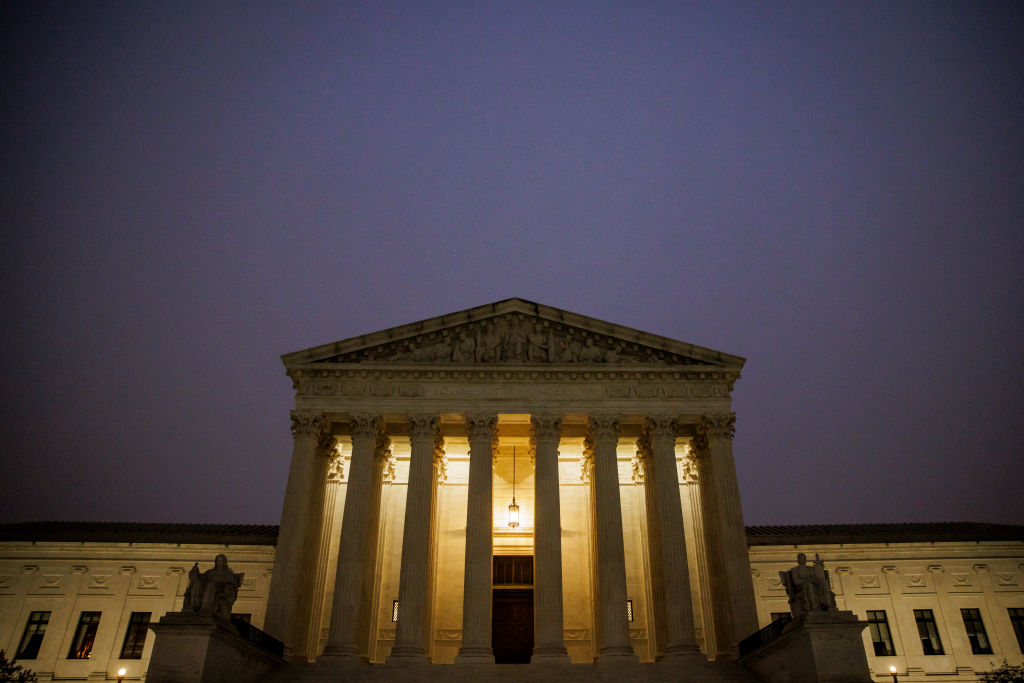
The Supreme Court on Tuesday morning turned down several petitions for review challenging the ban on the possession of guns by people who have previously been convicted of felonies. However, the justices did not act on a similar case brought by a woman convicted of passing a fake check nearly two decades ago. The announcement came as part of a list of orders released from the justices’ Jan. 16 conference. After adding four new cases to its docket for the 2025-26 term, the court did not grant any additional cases on Tuesday.
The court denied review in four cases brought by men who have been convicted of felonies – Zherka v. Bondi, Duarte v. United States, Collins v. Bondi, and Pierre v. United States. The justices did not act, however, on a petition for review filed by Melynda Vincent, a single mother who was convicted of check fraud and sentenced to probation 17 years ago for passing a fake check for $498.12 at a grocery store. Vincent was sentenced to probation. Now a licensed clinical social worker, Vincent is challenging the constitutionality of the federal felon-in-possession law as it applies to her. The Supreme Court has now considered Vincent’s case at five consecutive conferences.
Separately, and despite the Trump administration’s recommendation that it should take up the case, the Supreme Court declined to decide a question related to the interpretation of the Foreign Sovereign Immunities Act, a 1976 law that generally shields foreign governments from lawsuits in U.S. courts. The issue came to the court in Agudas Chasidei Chabad v. Russian Federation, a long-running dispute seeking to recover a religious library and archive seized by the Soviet Union and held in Russia.
The religious movement that had owned the library filed a lawsuit against the Russian government in federal court in Washington, D.C., seeking the library’s return. The FSIA carves out an exception – known as the “expropriation exception” to the general immunity rule in some cases involving property rights when the property “is present in the United States in connection with a commercial activity carried on in the United States by the foreign state” or “is owned or operated by an agency or instrumentality of the foreign state and that agency or instrumentality is engaged in a commercial activity in the United States.”
The U.S. Court of Appeals for the District of Columbia Circuit ruled that the Russian government had immunity under the FSIA. In its view, the exception applied to foreign governments only if they bring the property at the center of the case to the United States; it does not apply if the foreign governments give the property to a government agency or organization that does business in the U.S.
The religious movement came to the Supreme Court last year, asking the justices to weigh in. In December, at the court’s invitation, the Trump administration filed a “friend of the court” brief in which it urged the court to grant review. However, perhaps because two justices – Brett Kavanaugh and Ketanji Brown Jackson – recused themselves from the proceeding, the court denied review. Jackson indicated that she would not participate in the case because of “prior judicial service” – that is, participation in the case during an earlier stage while she was a judge on the D.C. Circuit. Although he did not explain his recusal, that is presumably why Kavanaugh also did not participate.
Jackson dissented from the court’s decision to reject a request from Danny Howell, an Indiana inmate serving a 70-year sentence, to file a petition for review “in forma pauperis” – that is, without paying the $300 filing fee and the more substantial costs of printing a Supreme Court brief. The court’s order provided that because Howell “has repeatedly abused this Court’s process,” he would not be able to file new petitions “in noncriminal matters” (such as habeas relief, which is civil) without paying the filing fees.
Jackson explained that “[e]ven if Howell were to identify meritorious grounds for habeas relief or wanted to bring a justifiable challenge to his conditions of confinement, he will now be prevented from doing so unless he pays the filing fee—no matter what.” Such a “categorical, forward-looking filing bar” is “intolerable as to incarcerated individuals,” Jackson wrote.
For the same reasons, Jackson noted similar dissents in three other cases: Allen v. Guzman, Sullivan v. United States, and Diehl v. United States.
The justices will meet again for another private conference on Friday, Jan. 23.
Posted in Court News, Featured, Merits Cases
Cases: Vincent v. Bondi, Agudas Chasidei Chabad of United States v. Russian Federation, Zherka v. Bondi, Duarte v. United States