The full Fed battle

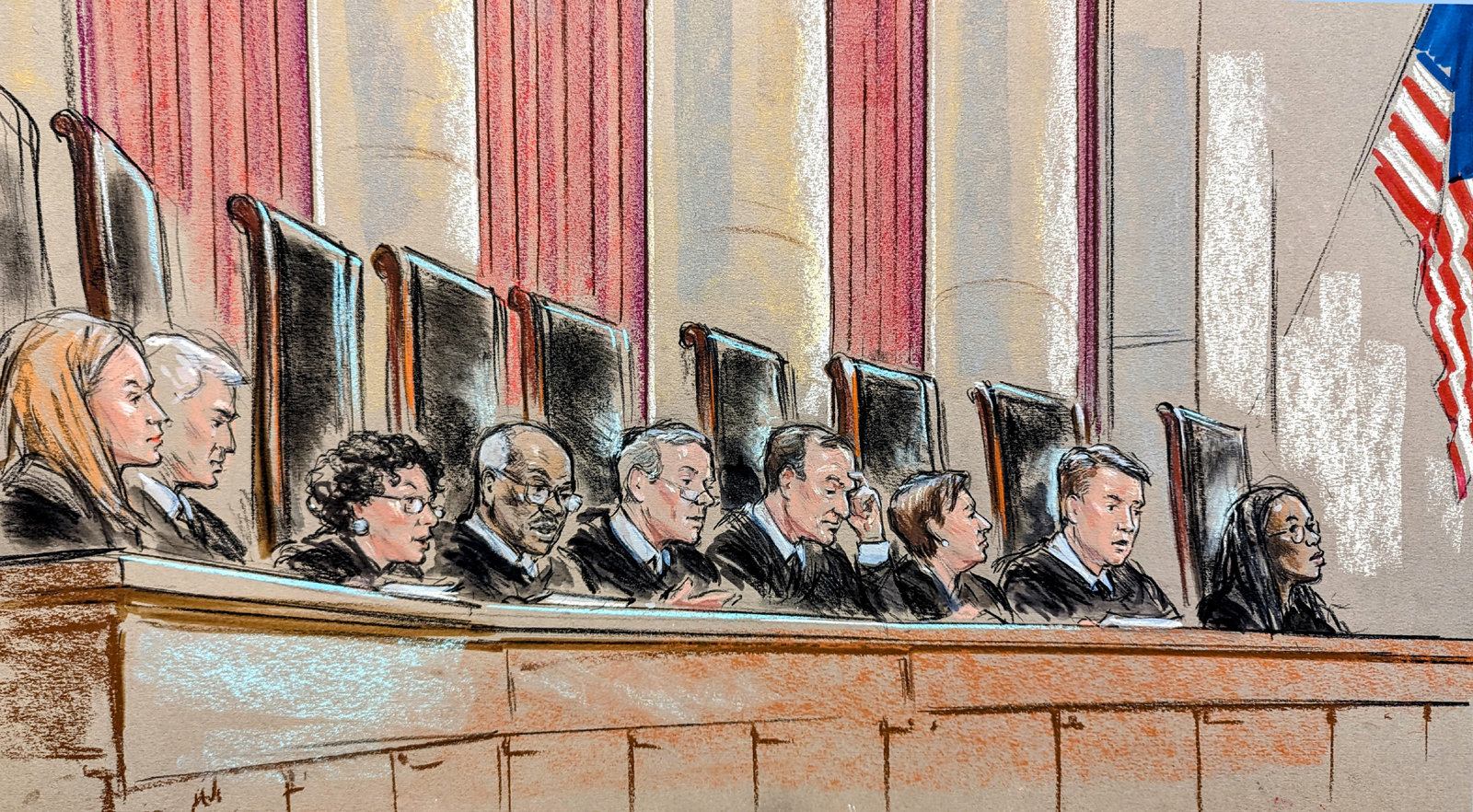
It is a crisply cold winter morning in Washington as people filed into the Supreme Court for Trump v. Cook, about President Donald Trump’s effort to remove Federal Reserve Governor Lisa Cook.
It is warm in the courtroom, though, and by the time reporters are escorted upstairs, some notable guests have already taken their seats in the public gallery.
Cook is in the middle section, second row. She is just a few seats away from where transgender student Becky Pepper-Jackson sat last week to hear arguments in her case, West Virginia v. B.P.J. There has been something palpable about these litigants being present in the courtroom that I do not believe is going unnoticed by the justices. (Not that such a presence necessarily guarantees any particular outcome.)
Also in the courtroom is the other Fed governor who had announced in advance he would attend this case considered critical to the independence of the nation’s central bank – Fed Chairman Jerome Powell. He is also seated in the second row of the public gallery, but one section over from where Cook is. (It is the section the farthest away from us pesky reporters.)
Powell is lean and it takes some of my colleagues a few seconds to spot him even after some guidance.
The Fed chairman appears to have shrugged off Treasury Secretary Scott Bessent’s criticism, in a CNBC interview on Tuesday, of his plans to attend the argument. Bessent said that would be viewed as an attempt by Powell to “put his thumb on the scale.” (Bessent attended arguments in November in Learning Resources, Inc. v. Trump, the big case over the president’s tariff policies.)
The Justice Department has launched an investigation of Powell over his testimony to Congress last year about renovations at the Fed’s headquarters here, and Trump has frequently criticized the Fed chairman. Meanwhile, Powell and the Fed are nominal defendants in Cook’s lawsuit. So, it seems Powell has some perfectly legitimate reasons to be here.
One row behind Cook is another familiar face – former Fed Chairman Benjamin Bernanke, who joined an amicus, or “friend of the court,” brief in support of Cook signed by every living former Fed chair, as well as some former Treasury secretaries and other former senior officials. Bernanke looks little different from when he appeared on the cover of Time magazine in 2009 as its “Person of the Year” for … saving the economy from collapse.
The rest of the gallery is pretty full, but the marshal’s office has not filled the vestibule chairs on our side of the room. (The same chairs on the other side are reserved for the justices’ law clerks, and many of those seats will be filled.)
In the justices’ guest box, one of the Jackson brothers arrives to take a seat. It is either Patrick Jackson, the doctor and husband of Justice Ketanji Brown Jackson, or his twin brother, William Jackson, a lawyer. Both have attended arguments, so it’s not clear to me which one is here today.
Today’s case involves a battle at the lectern between U.S. Solicitor General D. John Sauer and former Solicitor General Paul Clement, who served under President George W. Bush. This is Clement’s fifth argument of this term (and counting) and second argument of the January sitting (he argued for the oil company in Chevron USA v. Plaquemines Parish last week).
The two-hour argument was ably reviewed both in the SCOTUSblog live blog and in my colleague Amy Howe’s main story, so I’ll just offer a few observations.
Sauer begins his argument about the legal question of whether the court should stay the preliminary injunction by diving into the factual allegations regarding Cook’s mortgage applications that Trump contends impermissibly listed a home as a principal residence, resulting in a more favorable interest rate.
“The American people should not have their interest rates determined by someone who was, at best, grossly negligent in obtaining favorable interest rates for herself,” Sauer says.
(There will be quite a bit of discussion of these facts that are supposedly not expressly before the court, including Cook’s take that this was an inadvertent error and that she also submitted a document clarifying that the residence in question was a vacation home.)
Cook looks on intently, sometimes putting her hand to her face, hanging on every word without showing any reaction. My neighbor in the press section, Howard Mortman of C-SPAN, has noticed that seated near Cook appear to be several members of Congress, including Rep. Joyce Beatty, an Ohio Democrat who appeared earlier with other members for a press conference on the sidewalk outside the court.
Powell, meanwhile, sits stoically throughout the argument, leaning forward or moving his shoulders just a couple of times. (For the first time at 10:55 a.m., according to my notes.) Neither Cook nor Powell visibly turn to those around them to whisper any comments or reactions.
During arguments Tuesday in Wolford v. Lopez, a Second Amendment case from Hawaii, the chief justice had lost what I call a faceoff – when two justices try to ask a question at the same time, and one relents – to Justice Elena Kagan. Today, when he and Kagan again begin their questions at the same time, Roberts keeps talking as Kagan retreats.
A little later, when Sauer is in a colloquy with Jackson, his aggressive effort to speak over her prompts a rare rebuke from Roberts.
“Counsel, please allow the justice …”
Sauer apologizes before the chief justice finishes the thought.
Justice Brett Kavanaugh most directly addresses concerns about how a case like this might harm the Fed.
“[Y]our position that there’s no judicial review, no process required, no remedy available, a very low bar for cause that the president alone determines,” he tells Sauer, “I mean, that would weaken, if not shatter, the independence of the Federal Reserve that we just discussed.”
Clement, for his part, moves quickly from his formal opening to the folksy turns of phrase he likes to pepper his arguments with, and which the justices seem to like.
Responding to a question from Kagan, Clement says, “And if, heaven forfend, we end up with a whole common law of Fed governor removal, then we might eventually be able to sort of piece … together” the government’s theory of gross negligence. The only other person I know who uses “heaven forfend” is C. Montgomery Burns, and he’s a cartoon character.
Asked by Justice Clarence Thomas about how the president might conduct a due-process hearing for Cook, Clement says, “one example we have historically is President [William Howard] Taft, and he sort of gave the removed officials the full Taft, and it was notice, opportunity for a hearing before an impartial tribunal that, you know, serendipitously included future-Justice [Felix] Frankfurter. … But we’re not suggesting that you need to give the full Taft.”
Clement’s only uncharacteristic slip today is when he refers to Sauer as “Gen. Souter.” (Or perhaps it was Gen. Suter. William Suter, a retired Army general, was the clerk of the Supreme Court when Clement was solicitor general and Justice David Souter was on the bench.)
Toward the end of his time, Clement makes a broad point.
“It’s less important that the president have full faith in every single governor, and it’s more important that the markets and the public have faith in the independence of the Fed from the president and from Congress.”
When the case is submitted, Powell exits quickly with his security detail down one of the grand staircases from the first floor to the ground level, presumably to his motorcade. Cook slips out with the rest of the crowd.
The consensus in the Press Room is that it has been a good day for Cook, Powell, and the Fed. On the plaza, reporters have been told Cook might come to the microphones, but she is a no-show.
The temperature has risen, and wherever she is, the warmth of the winter sun may feel pretty nice to her this afternoon.
Cases: Trump v. Cook (Independent Agencies), Trump v. Cook